Know how each of your people works best. Then manage them that way.
Aperio gives every employee their own workplace profile, and gives their manager a short list of what to do differently: how to brief them, how to give feedback, what gets their best work.
Where someone needs an adjustment at work, it is agreed, recorded and reviewed in one place. Built for neurodivergent and neurotypical staff alike, on peer-reviewed frameworks rather than a personality type.
Sent a code by your employer? Enter it here →
Most assessments hand you a report. Aperio hands your managers a list of things to do.
A personality test gives you a PDF and stops. Aperio turns each profile into specific, practical actions for the person's manager, and keeps a record of what was agreed.
Before the first one-to-one
The manager already knows how this person likes to be briefed, how they take feedback, and what conditions get their best work.
Adjustments done properly
An employee chooses what to share. The manager records what was agreed, puts it in place, and a review date comes round. There is a written record if it is ever questioned.
Teams built with the gaps visible
See who leads with ideas, who holds focus, who holds the team together, and which style nobody in the team has.
New starters managed well from day one
Add a person to your roster, send them a code, and their manager has their profile before the first week is out.
Training needs from your own figures
The dashboard tells you what training your organisation would benefit from, with the course that covers it, or tells you to speak to HR.
No health data on your side
Executive-function scores and any screener result stay with the employee. You get the part you can act on and none of the risk.
Four steps. No software to install.
An access code is a one-time link that lets one person complete one assessment. You send codes from your dashboard; nobody needs an account to start.
Two views: the individual's report, and your dashboard.
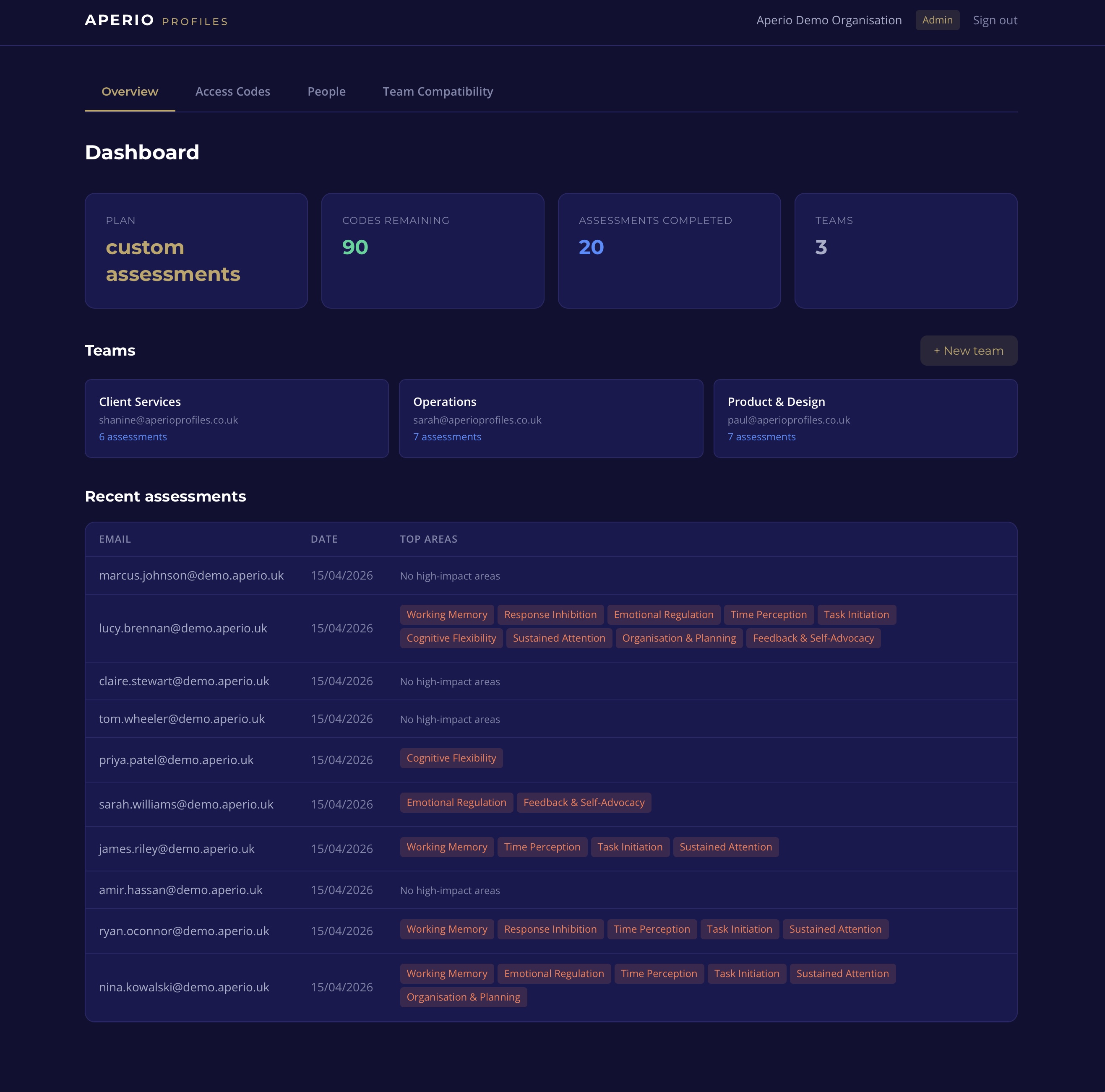
Each person gets their own full report. Your organisation gets a dashboard showing who has completed what, how each person works best, and the adjustments they have agreed to share. The screens below are from both sides: your dashboard, an individual's Workplace Profile report, and a standalone screener result.
One profile for everyone. Three screeners employees can ask for.
The Workplace Profile is the core product and every employee gets one. The screeners are optional: an employee requests one privately from their own account, you approve the request without being told who asked, and the result goes to them.
Workplace Profile
How a person plans, focuses, organises and handles pressure (executive function), plus their workplace personality, in one plain-English report with specific recommendations for them and their manager.
Every employee. Also sold to individuals.
ADHD Workplace Screener
A self-report screener for ADHD-consistent patterns at work, with separate thresholds for men and women and checks that help separate anxiety, depression and burnout. Not a diagnosis.
Employees who want it. Also sold to individuals.
Autism Workplace Screener
Covers social communication, sensory experience, executive functioning, pattern recognition and masking (hiding autistic traits to fit in), with separate thresholds for men and women. Not a diagnosis.
Employees who want it. Also sold to individuals.
Workplace Bias Awareness Screener
Eight areas of workplace bias, from gender and race to age, disability and family. Workplace situations rather than abstract questions, with a personal report and practical next steps.
Organisations and teams.
Every profile names the way a person works best.
From the person's own answers about the conditions they work best in. A style is a preference, not a rating, and someone can hold more than one. Managers see it on the dashboard; the person sees it on their report.
What each style needs from a manager ▾
They do their best thinking out loud, in fast discussions where people build on each other's ideas. They are most useful at the start of a piece of work, when the question is still open and the options have not been narrowed down.
- Bring them in early, when the problem is still being defined, not after the plan is set.
- Give them someone to think with. A fast two-way conversation gets more out of them than a written brief.
- Separate idea generation from decision and delivery, and capture the decisions in writing afterwards.
They work best with company. Having another person alongside them, even on separate tasks, helps them start, keep going and finish. They tend to be the person who gets collaboration going.
- Pair them up. Co-working sessions, shared tasks and working in the same room or on the same call are productive conditions, not perks.
- Avoid leaving them on long solo pieces with no contact. If the work is solo, build in regular check-ins.
- Use them to bring new starters in and to connect people across teams.
They do their best work when they are helping the people around them get on and work well together. They read the room, notice when something is off between people, and tend to be the one who keeps a team working as a team.
- Ask them how the team is working together. They will often have noticed something you have not.
- Give them a real part in how the team runs: onboarding, handovers, the conversations that stop friction becoming conflict.
- Make it safe to raise problems with you. Holding a team together can mean carrying things they do not say.
They do their best work when things are moving fast and decisions are needed now. Pressure sharpens them rather than flattening them. They are the person people want in the room when something has gone wrong.
- Give them real responsibility in time-critical work: incident handling, deadline-critical delivery, live decisions.
- Keep pressure episodic. A crisis is a condition this person thrives in; a permanent state of crisis is not.
- In quiet periods, give them something with a real edge to it rather than filler.
Their best work comes from long, uninterrupted stretches on one thing. Quiet and single focus are the conditions they need, and the quality of their work rises sharply when they get them.
- Protect blocks of focus time and keep meetings off them.
- Give one clear priority at a time, in writing, rather than a changing list.
- Batch questions and interruptions. A single daily check-in beats five quick ones.
They work best when they are in charge of their own work: organising it, keeping it on track and delivering it without someone looking over their shoulder. They would rather run the plan than be run by it, and they do that best alone.
- Agree the outcome, the deadline and the constraints, then step back.
- Check in at milestones, not daily. Ask what they need rather than how it is going.
- Give them authority over their own process. If the result is right, the route is theirs.
Priced per employee. Everything included.
You pay for the people on your Aperio roster, in bands: the first 49 people at one rate, the next at a lower rate, and so on. Plans start at 10 employees. All prices exclude VAT.
Per employee, per month
Billed yearly. Minimum £2,500 a year.
| First 49 people | £10 |
| 50 to 249 | £7.50 |
| 250 to 999 | £5 |
| 1,000 and over | By quote |
What that looks like
| 20 employees | £2,500 a year |
| 50 employees | £5,970 a year |
| 100 employees | £10,470 a year |
| 250 employees | £23,940 a year |
| 500 employees | £38,940 a year |
Included in every plan
- ✓A Workplace Profile for every employee on your roster, including new starters and re-takes during the year
- ✓The organisation dashboard: people, teams, team compatibility, training needs
- ✓Adjustments tracker with review dates and a written record
- ✓Screener codes (ADHD, autism, bias) at one per 5 employees per year; more in top-up packs
- ✓Psychological safety survey
- ✓Drive and Direction Profile when it launches, at no extra cost
- ✓Email support and onboarding guides for admins and managers
Fewer than 10 people? Buy individual profiles at £80 + VAT each. Extra screener codes: packs of 5 for £375, 15 for £1,050, 25 for £1,625, 50 for £3,000, plus VAT.
You never hold your employees' health data. The platform makes sure of it.
Screening results touch on mental health, which is special category data under UK GDPR. Holding it brings duties and risk you do not need. Aperio keeps that side with the employee and shows your managers only the part they can act on.
- Each person's working style and what they work best with
- Workplace personality, in a work context
- Only the adjustments the person chooses to share
- Anonymous organisation-wide screener figures, never names
- Executive-function scores and raw answers
- Any ADHD, autism or bias screener result
- Whether they took a screener at all
- Anything they have withdrawn
Employees can share, contest or withdraw at any time and every change is recorded. Full detail on the data protection page.
Not buying for a team? Get your own profile.
Thirty minutes of questions. In return: how you plan, focus, organise and handle pressure, where work costs you more than it should, the conditions that get your best work, and the exact changes to ask for. Plus your working style and what you need from a manager.
£96 including VAT, one payment. The link arrives by email straight after. You keep your own account and report, and you decide what, if anything, to share with an employer.
Where to go
I was sent a code
Enter your code →I am an employee or bought my own profile
Log in →I manage a team
Manager login →I run our organisation's account
Organisation login →An access code comes from your employer or from your own purchase. It is not a discount code.
Ready to understand your people properly?
A 30-minute call is the quickest way to see whether Aperio fits your organisation.